When You Can't Afford the Elevator, Design the Bottle
Leave a message
When You Can't Afford the Elevator, Design the Bottle
BAT is betting the next decade on pouches. The trade show is betting on slowness. Both are answering the same question, and a hardware maker only has one way to answer it.
In April 2026, at OMR in Hamburg, British American Tobacco built a lift. Visitors stepped inside, the doors shut, and for the length of the ride they watched the city slide past below. No puff counter. No product demo. BAT's press note described the intention as a deliberate moment rather than a fleeting thrill.
Six months later a cigar expo opened in Chengdu under the theme "Slow Burn". No booth walls - a market you wandered through instead: cigar smoke, tea, baijiu, intangible-heritage craft tables, and a guochao electronica set in one corner. The pitch was simply, sit down for a while.
Two very different rooms, one conclusion: almost nobody buys at the stand any more.
The eighty-five and the six
Here are three numbers that should keep an exhibition manager awake. Roughly 85% of exhibitors say they attend a show to win business and close sales. About 6% actually convert. Meanwhile 74% of visitors say a single meaningful conversation makes them more likely to buy.
Put those side by side and the hall starts to look like what it is: a room full of sellers, selling to each other, while a small number of buyers quietly note who treated them like a person instead of a lead.
That is why the interesting budgets walked away from the stand. ProCigar has run its cigar festival for eighteen years; the 2026 edition went out under "Our Soil and Soul" and put visitors in a field, then at a rolling table at La Aurora where they rolled their own cigar and took it home. Toyota at ComplexCon made people play a shooting game before they could earn a paper flower. PMI turned its InterTabac space into a boulevard - IQOS boutique, ZYN café, Marlboro office, a separate room for VEEV, each with its own front door.
None of that is decoration. It is an admission that the product demo has run out of road.
85% exhibitors who attend to win business and close sales | 6% who actually convert | 74% visitors who say one real conversation lifts intent to buy | 23% modern oral CAGR, 2025 to 2030 |
Where the money actually moved
On 29 September 2026 BAT held its capital markets day in Winston-Salem, North Carolina - Reynolds' hometown, chosen on purpose - and walked investors through Horizon 2030.
The headline commitments: new-category revenue growing at a mid-teens rate through 2030; contribution margin from new categories of at least 30%; 50 million adult consumers of smokeless products; and more than £50 billion of cumulative free cash flow between 2024 and 2030.
Then the sentence that matters more than any of those: modern oral is now BAT's largest new category by revenue. Not vapour. Oral.
The arithmetic behind the shift is blunt. Global nicotine revenue is forecast to grow about 4% a year from 2025 to 2030; new categories at 13%; modern oral at 23%, the fastest line in the table. BAT's own contribution margin in new categories was 13.8% in the first half of 2026, while new-category revenue rose 18% and modern oral rose 65.9%. Growth was never the problem. Margin is.
That explains why 2026 guidance sits at the low end of the revenue and profit ranges, why the shares fell after the briefing and sit about 14% lower over the past 90 days, and why Jefferies only nudged its target from 5,500p to 5,600p. The regulator has not helped either: in August 2026 the FDA issued marketing denial orders for six flavoured Vuse Alto products, and the nicotine-pouch authorisation pilot has slowed.
Three routes, one finish line:
| Company | Route | Latest proof point |
|---|---|---|
| PMI | Replace the revenue | Smokeless at about 42% of Q2 2026 net revenue, sold in 109 markets, IQOS shipments up 7.6% |
| JT | Build a second leg | Reduced-risk revenue up 40.7%, Ploom up 43.5%, breakeven targeted for the end of 2028 |
| BAT | Relay the profit | New-category revenue up 18% in H1 2026 on a 13.8% margin, against a 30% target for 2030 |

A factory's only experiential channel
Which brings us to the awkward part for anyone who makes hardware.
Pouches, cigars and heated tobacco are slow categories. They need explaining, a person to walk a consumer through the first week, a reason to come back. That is what a lift and a garden market are for. A device maker has none of it. We do not own retail educators. We cannot rent 270 degrees of LED in Hamburg. In several of our markets we cannot legally advertise at all.
The only medium left is the object.
This is the honest reason a 50,000-puff device now turns up shaped like a champagne bottle: 600 mAh, 22 mL of liquid, a 0.9Ω coil, 2% nicotine. On paper the specification is ordinary for this class. The format is not. On a counter it reads as a gift before it reads as a vape, and the gold, emerald and silver finishes do the job a shelf-talker would do in a market where shelf-talkers are illegal.
 | 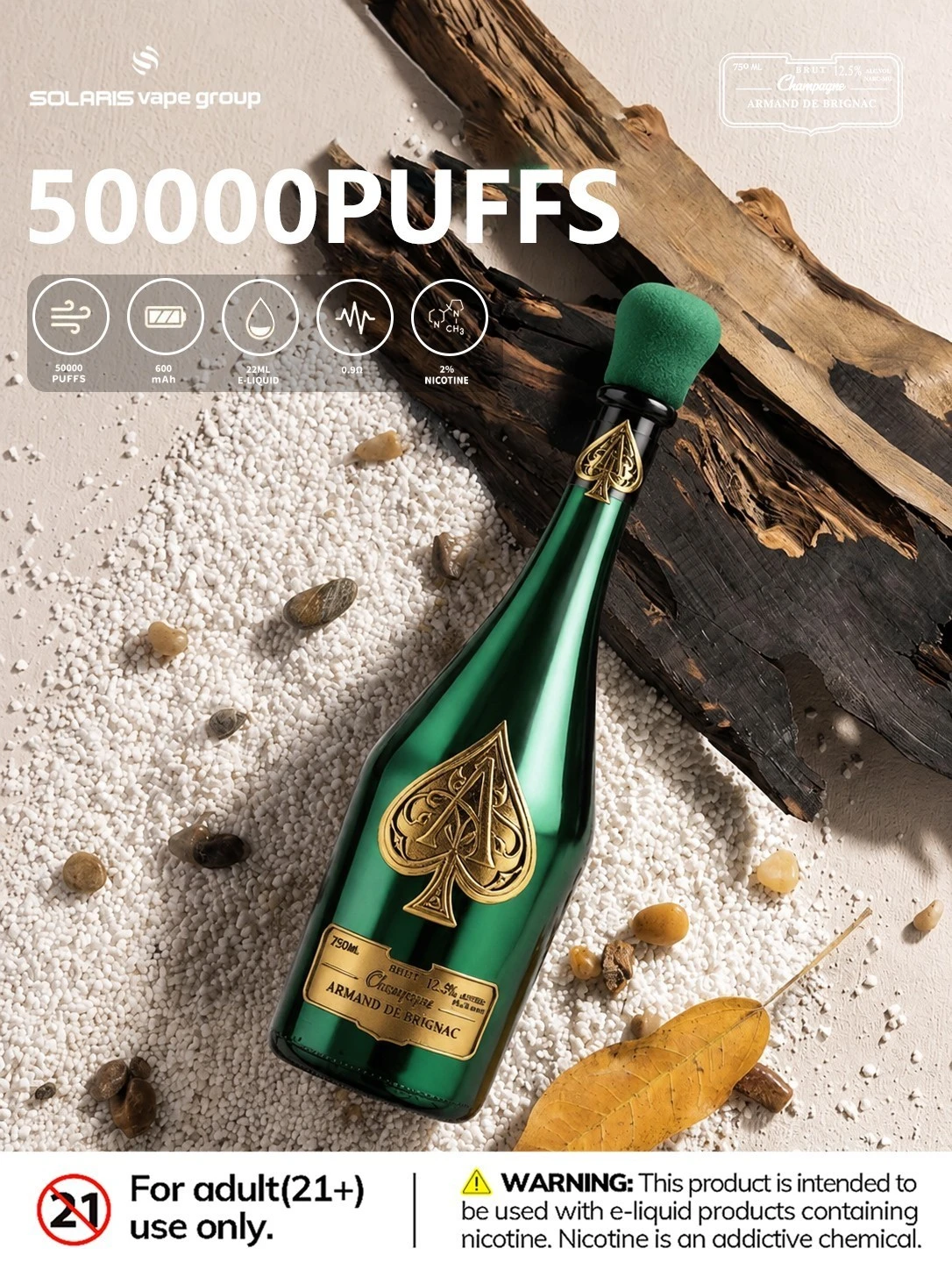 |
Three finishes, three price tiers, one mould. On the right, the same shell shot in daylight rather than darkness - closer to how a distributor's catalogue will show it.
| A trade show buys six seconds of attention for six figures. A mould buys the same six seconds on every counter you can reach. |
Two things worth saying out loud
First, the format is not welcome everywhere. Packaging that echoes alcohol draws extra scrutiny in several markets, and the rules on youth appeal are tightening rather than loosening. Before a distributor books a container of anything that looks like champagne, somebody should read this year's rules rather than last year's. We would rather lose the order than the licence.
Second, a striking shell creates attention, not a category. ProCigar has run for eighteen years and it serves people who already smoke cigars. Slow experience is very good at deepening an existing circle and poor at widening one. A bottle gets picked up and looked at. It will not explain to a smoker why they should switch, and it will not reassure a regulator.
That work still needs a person, a leaflet and a room - which is precisely what the big companies are paying for.
Two clocks are running
BAT's is the long one. Combustible cash flow has to hold until pouches earn their margin, and 2028 is the first honest reading: JT's reduced-risk business is due to break even that year, and BAT's new-category margin should be visibly climbing toward 30%.
Ours is shorter. A factory without a brand budget has one product, one shelf and roughly four seconds of a buyer's attention. A format that earns a second look is not vanity. It is the cheapest media available to us, and the only kind that crosses a border inside a carton.
Design the bottle. Then read the rules before you print the label.
We build disposable, pod and refillable systems for distributors across the UK, Europe, the Middle East, Southeast Asia and Africa, and we are happy to argue about formats. Specifications, finishes and market notes on request - joylifevape.com
BAT capital markets day, 29 September 2026, and H1 2026 results; PMI and JT Q2 2026 results; OMR 2026 and InterTabac 2026 show coverage; ProCigar 2026 programme; Chengdu cigar expo, October 2026; FDA marketing denial orders, August 2026; exhibition conversion statistics as cited in industry coverage. Category growth rates are company forecasts for 2025–2030. Figures rounded for readability.
For trade and business audiences only. Nicotine products are age-restricted to adults 21+ where applicable, and product formats, packaging and marketing are subject to local law. Nothing here is legal advice or a compliance certification for any product.